Saturday, March 13, 2010

Almanac of the Dead


The people had been free to go traveling north and south for a thousand years, traveling as they pleased, then suddenly white priests had announced smuggling as a mortal sin because smuggling was stealing from the government.
Zeta wondered if the priests who told the people smuggling was stealing had also told them how they were to feed themselves now that all the fertile land along the rivers had been stolen by white men. Where were the priest and his Catholic Church when the federal soldiers used Yaqui babies for target practice? Stealing from the "government"? What "government" was that? Mexico City? Zeta laughed out loud. Washington, D.C.? How could one steal if the government itself was the worst thief?
There was not, and never had been, a legal government by Europeans anywhere in the Americas. Not by any definition, not even by the Europeans' own definitions and laws. Because no legal government could be established on stolen land. (133)

* * * * *

Guzman's people had always hated her anyway. Because she was an Indian. "We know," Lecha said. "We know that. But what about the trees?"
Oh, yes, those trees! How terrible what they did with the trees. Because the cottonwood suckles like a baby. Suckles on the mother water running under the ground. A cottonwood will talk to the mother water and tell her what human beings are doing. But then these white men came and and they began digging up the cottonwoods and moving them here and there for a terrible purpose.
(117)

* * * * *

He thought about what the ancestors had called Europeans: their God had created them but soon was furious with them, throwing them out of their birthplace, driving them away. The ancestors had called Europeans "the orphan people" and had noted that as with orphans taken in by selfish or coldhearted clanspeople, few Europeans had remained whole. They failed to recognize the earth was their mother. Europeans were like their first parents, Adam and Eve, wandering aimlessly because the insane God who had sired them had abandoned them. (258)

Congo and Conflict Minerals

Let me clarify that I have been aware of the wars in the Congo for a long time. But I think that if my ability to feel shocked and want to tear the hair from my skull were exhausted, it would mean that I'm either dead or cynical to the bone.

I'm neither of the above yet I am one of the millions of people who reap benefits of these wars: I do have appliances that contain minerals stolen from the Congo. And I do feel stupid, wrong, and at the same time cheated because of that.

And so what?

I think we're in a situation where none of this can carry any weight. It's hard to even make it sound genuine, since my outrage is only a drop in a sea of outrage and mere outrage can't do anything. And where does the exploitation stop if we're increasingly oblivious of the way our pretty toys are produced? It's "invisible hands" and "fairy material" and only if you really bother to ask yourself about the path each part of your laptop or cell phone has traveled will you--perhaps--realize that the trip began in one of those areas of the world that have rare natural resources: stuff necessary for your laptop to work, stuff necessary for your stupid cell phone to vibrate...

I hope some day (soon!) this will stop happening.

Saturday, March 6, 2010

I Adore Kate Beaton

Kind of like Verne adored Poe (probably my favorite strip, this one). More balloons for everybody!

This one, which I found today, is very close to my current research.

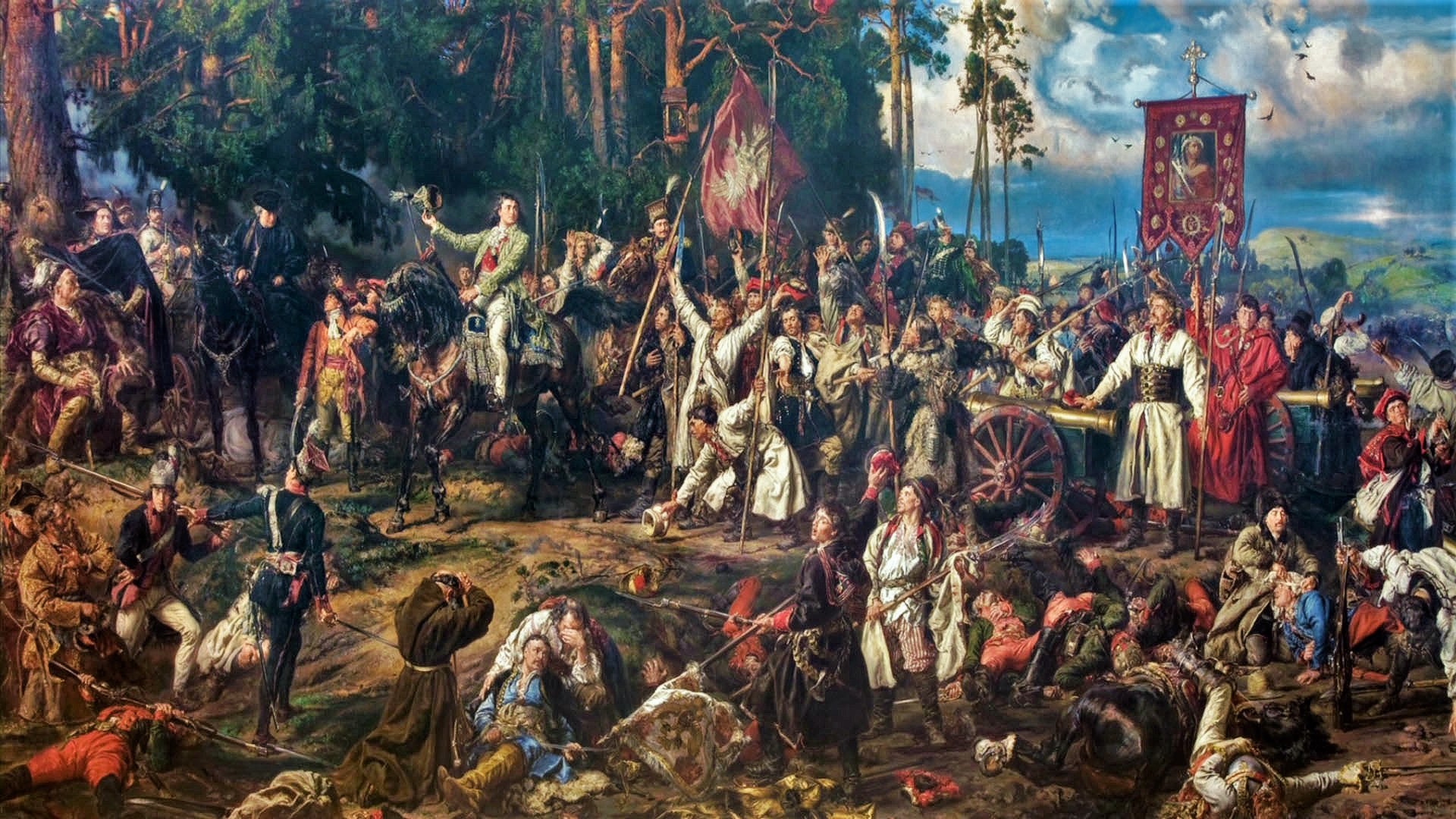
Very true: Kościuszko's Insurrection was "crazy shit"--lots of upturned scythes (unfortunately, Wikipedia won't tell you about that in English).


Jan Matejko, Bitwa pod Racławicami [The Battle of Racławice], 1888 - image from Wikipedia

Sunday, February 28, 2010

Jeśli lubisz Trzęsidzidę

Verbatim translation: If you like Shakespeare.

I spent all my First Communion money on a lexicon of painting (exactly on this one, but back then internet was not where you found it) and I thought this was the most enchanting painting in the world:


Years later I heard about Elizabeth Siddal's anguish--posing for Millais in a bathtub of cold water. I wish someone would discover a secret alternative version of the painting or a sketch of Siddal on her break: reading a book in that bathtub, adding warm water on the sly.

Saturday, February 27, 2010

Overcoming Intrusion? Egon Schiele: Sitting Woman With Legs Drawn Up

It took me a long time to come to terms with Egon Schiele. Much of his art repelled me (still does, to be honest) because of its voyeurism and obtrusive sexualization of little girls.

Much of his art is like a magnet, though. There is an expressive economy of lines in his sketches: there always appears to be enough, though it seems he drew only what was absolutely necessary to make the image legible.

The perspective is often difficult to figure out--sometimes it seems we're looking at the figure from an uncomfortable position at the ceiling, sometimes it seems we're crouching on the floor--but we're always close, in the model's personal space. So close that it's possible to feel like an intruder in a Schiele painting.

When I found KatColorado's re-enaction of Schiele's Sitting Woman... on Flickr, it got me thinking about that problem of intrusiveness and of tableaux vivants (one of those pastimes I can never understand).

KatColorado repeats the brilliant composition, the pose, almost the same perspective. Maybe it's just my hopeless attachment to text but her brief description of how she went about the project sets it apart from Schiele's invitation to intrude.

I don't mean to go all Marie Bonaparte* on Schiele, but having read about his troubled relationship with his mother, his use of his sister Gerti and then later Wally Neuzil and the Harms sisters as models, I can't quite separate that knowledge from the violence in his representation of women. The photographer re-enacting the painting isn't putting herself just in the position of the model but in multiple roles at once. Unlike in the haunting description of tableaux vivants in The House of Mirth, the issue here is not exact embodiment of the figure in the painting but re-doing the painting. (So KatColorado can survive the experiment, unlike poor Lily Bart?)

It leaves me still not understanding tableaux vivants but more at ease with the masochistic appeal of Schiele's work. I like the photograph. If you know more projects of this kind, drop me a line.

Egon Schiele: Sitting Woman With Legs Drawn Up (1917), originally uploaded by KatColorado

[While the dead cities and dead children paintings are incredible in their own way, I have no idea how to weave them in here, so I bracket them for now. Voilá!]

*Marie Bonaparte was a disciple of Freud's and author of a psychoanalytical interpretation of the life and works of Edgar Allan Poe, notorious for its vision of art as symptom of the artist's psychological issues.

Friday, February 26, 2010

Snow Day, Snow Death

The jokes are over. This is my neighborhood yesterday:


(Photos courtesy of my favorite photographer)

I don't have pictures from today. Take a piece of paper, draw a narrow margin of graphite at the top, and let's say it's the sky today. Below that you have between 2 and 3 feet of snow (and growing). That's right: I live in an amateur illustration for Jack London's "To Build a Fire."

It's almost March. I still need to get to work today. Did I already mention I hate snow?

Sunday, February 21, 2010

Illustrations and Ephemera for Uncle Tom's Cabin


I recently had the chance to look at several nineteenth-century illustrated editions of Uncle Tom's Cabin, responses to the novel, and children's books of verse and tales based on the novel. The amount of material generated already as the installments of Stowe's novel were appearing in The National Era is astounding. If you think that the gadget madness started with Lucas's Star Wars, you need a sentimental trip to the sentimental edge of the nineteenth century.

I post here a few highlights from a random web image search.


Images, from left, with links to original sites: [1] [2] [3] Eliza's escape across the frozen Ohio river; [4] Dinah holding little Eva; [5] [6] Eva and Topsy; [7] Eva with Tom

Babie lato, or, the One I Always Got Wrong

 
Józef Chełmoński, Babie lato (1875)

Babie lato [Gossamer] is the painting that haunted me throughout childhood, mostly because it hung in my grandmother's living room and then I saw it in the museum with my grandparents. What troubled me about it was that I was sure the figure in the picture was a boy but the title - verbatim: women's summer - introduced some doubt. It was only after a few years in school that I learned that babie lato meant either gossamer or Indian summer. It took several more years before I realized the figure was not a boy but a peasant woman.

What I still don't get is why this Polish peasant woman is wearing a bright yellow turban.

But now my focus has shifted to the dog. It always makes me smile.